Crossed Portrait – Advancing Energy Security Through Franco-American Collaboration
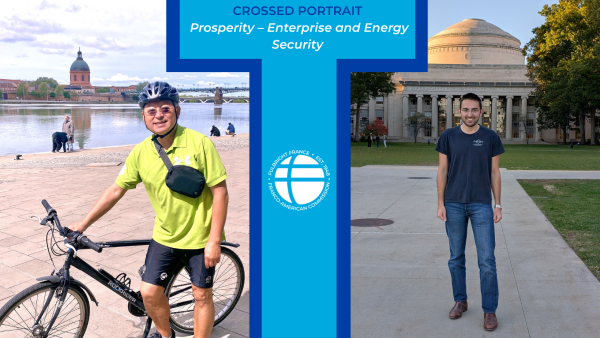
As part of the America250 / Freedom250 celebrations, Fulbright France highlights the power of transatlantic collaboration in addressing global challenges. For the month of March, dedicated to the theme “Prosperity – Enterprise and Energy Security,” we are proud to feature two Fulbright scholars whose work contributes to shaping a more sustainable energy future: Dr. Bin Yang, Fulbright-Tocqueville Distinguished Chair, and Nicolas Trosino, Visiting Student Researcher.
Dr. Bin Yang – Building a Global Bioeconomy for Decarbonization
A professor at Washington State University, Bin Yang joined the Toulouse Biotechnology Institute (INSA Toulouse) as part of his Fulbright-Tocqueville Distinguished Chair (2024–2025). His research focuses on advancing biomass processing technologies to produce sustainable biofuels and bioproducts, contributing to global decarbonization efforts.
Dr. Yang has made transformative contributions to the field of bioenergy and sustainable engineering, advancing technologies that address critical global challenges in renewable energy and resource efficiency.
With over 155 peer-reviewed publications, six patents, and numerous international collaborations, Dr. Yang is a leading expert in the bioeconomy. His work spans a broad range of innovative technologies to transform biomass into jet fuel, bioplastics, hydrogen carriers, and other sustainable materials.
Through his Fulbright experience, Dr. Yang has strengthened partnerships between the United States and France, bringing together academic, industrial, and institutional actors to address pressing environmental and energy challenges.
“My Fulbright–Tocqueville Distinguished Chair experience in France was transformative, providing a unique platform to engage with leading researchers and institutions at the forefront of the bioeconomy,” Dr. Yang said.
“In close collaboration with French and European scientists from academia, industry, and government agencies, I joined partners in developing ideas to address global environmental and energy challenges, enabling the exchange of complementary expertise and accelerating innovation in sustainable bioenergy and bioproducts research.
“Addressing climate and energy challenges on a global scale requires strong international partnerships that bridge scientific, cultural, and policy perspectives,” he added. “The advancement of a global bioeconomy clearly depends on a collaborative, partnership-driven approach among nations to ensure a sustainable future and the responsible sharing of the planet’s resources. I believe the Franco-American Fulbright Commission plays a vital role in fostering such partnerships in research and education, and I would welcome the opportunity to continue working with the Commission to advance sustainable bioeconomy development in the near future.”
Nicolas Trosino – Rethinking Nuclear Energy Systems
On the other side of the Atlantic, Nicolas Trosino, a PhD candidate at CentraleSupélec (Université Paris-Saclay) for HEXANA (a FRANCE2030 nuclear startup), conducted research at the Massachusetts Institute of Technology (MIT) as a Fulbright grantee.
His work focuses on the integration of thermal energy storage with nuclear power plants, aiming to improve grid flexibility and support the decarbonization of both electrical and industrial energy systems. By exploring the interactions between nuclear energy, renewable sources, and energy storage, his research contributes to the design of more resilient and efficient energy systems.
At MIT, Nicolas was able to accelerate his research while contributing a European perspective to American energy modeling approaches, highlighting the importance of methodological diversity in tackling complex global issues.
“The Franco-American Fulbright Commission support has been pivotal in internationalizing my PhD research. In the same way as in all phases of a nuclear program, the value of conclusions is enhanced by the expansion of the range of perspectives, approaches, and proofreaders. Ultimately, this accelerates decarbonization and enhances energy security.
The methodologies that were implemented during my five-month tenure at MIT significantly expedited my academic and industrial research for HEXANA. Conversely, I made a significant contribution to MIT's energy forecasting efforts by providing a French methodological critique that was instrumental in identifying blind spots.
In essence, it has been a successful international collaboration that demonstrates the significance of international partnerships and bilateral programs in resolving global-scale issues.”
A Shared Commitment to Global Challenges
Although their research fields differ between bioeconomy and nuclear energy, Dr. Yang and Nicolas Trosino share a common goal: advancing sustainable energy systems through innovation and international collaboration.
Their journeys illustrate how Fulbright programs go beyond academic exchange, fostering long-term partnerships, cross-cultural dialogue, and collective solutions to global challenges. By connecting expertise across borders, Fulbright continues to play a key role in building a more sustainable and secure energy future.